
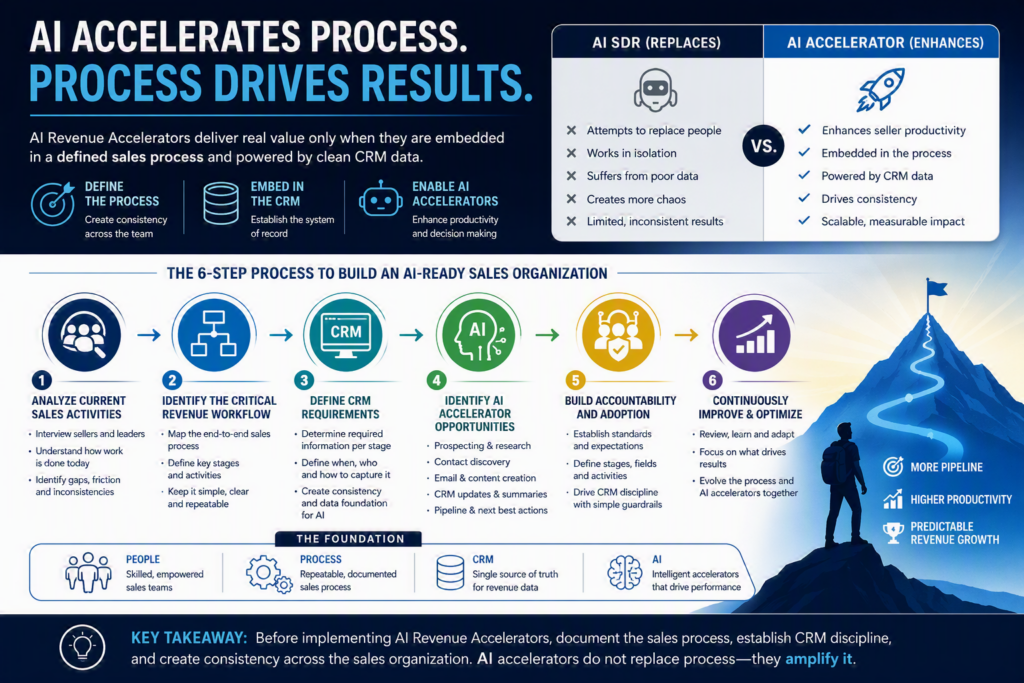
Why Sales AI Accelerators Require Process Discipline
AI Doesn't Fix a Broken Sales Process
The Hard Truth About Sales AI
Many organizations are exploring AI SDRs, sales agents, and revenue automation tools hoping to generate more pipeline, automate follow-up, and improve sales productivity. Unfortunately, many of these initiatives fail—not because the technology is bad, but because the underlying sales process is undefined, inconsistent, or ignored.
AI works best when it operates within a well-defined business process.
If every salesperson manages opportunities differently, stores information in different locations, skips CRM updates, or follows their own version of the sales cycle, AI has no consistent framework to support. The result is poor recommendations, inaccurate data, inconsistent automation, and disappointed expectations.
Before implementing AI Revenue Accelerators, organizations must first answer a fundamental question:
Do we have a documented sales process that our team actually follows?
If the answer is no, AI should not be your first investment. Process should be.
AI Accelerators vs. AI SDRs
Many AI SDR vendors position AI as a replacement for salespeople. We believe that approach misses the point.
The most successful organizations use AI as an accelerator—not a replacement.
AI Revenue Accelerators are designed to support and enhance existing sales activities:
- Prospecting
- Account research
- Contact discovery
- CRM updates
- Email composition
- Follow-up management
- Pipeline analysis
However, these accelerators only create value when they are embedded into a repeatable sales process.
Without process, automation becomes chaos.
Without CRM discipline, AI operates on incomplete or inaccurate information.
Without clear stages and responsibilities, AI cannot reliably determine what action should happen next.
Why CRM Adaption Matters
The CRM is not simply a place to store contacts.
It is the operational foundation that allows AI to participate in the revenue process.
When sales activity lives in email inboxes, spreadsheets, notebooks, and individual memory, AI cannot see what is happening.
When the CRM becomes the system of record, AI gains visibility into:
- Accounts
- Contacts
- Opportunities
- Activities
- Meetings
- Communications
- Pipeline status
- Next actions
From there, AI can begin helping salespeople instead of creating additional administrative work.
The 6-Step Process for Building an AI-Ready Sales Organization
Step 1: Analyze Current Sales Activities
Before documenting a future process, understand how work is currently performed.
Interview sales leaders and salespeople to answer questions such as:
- How are prospects identified?
- How are leads qualified?
- When are opportunities created?
- How are follow-up activities managed?
- What information is captured in CRM?
- What happens after meetings?
- How are stalled opportunities addressed?
The goal is not to judge the current process.
The goal is to understand reality.
Many organizations discover they don’t have one sales process—they have ten different versions being executed by ten different salespeople.
Step 2: Identify the Critical Revenue Workflow
Focus on the core activities that directly impact pipeline creation and opportunity advancement.
Examples include:
- Target account identification
- Prospect research
- Initial outreach
- Qualification
- Discovery
- Proposal development
- Opportunity management
- Follow-up
- Close/Won
- Customer transition
Keep it simple.
The best sales processes are clear, repeatable, and easy to understand.
Complexity is the enemy of adoption.
Step 3: Define CRM Requirements
For every stage of the sales process, determine:
- What information must be captured?
- When must it be captured?
- Who is responsible?
- What fields are required?
- What activities must be logged?
For example:
Discovery Stage
Required CRM Information:
- Decision maker identified
- Pain point documented
- Current solution documented
- Estimated budget
- Expected timeline
- Next meeting scheduled
This structure creates consistency across the sales organization.
More importantly, it creates the data foundation that AI requires.
Step 4: Identify AI Accelerator Opportunities
After the process is documented, identify where AI can improve efficiency.
Typical opportunities include:
Prospecting Accelerator
- Research target accounts
- Gather company intelligence
- Identify buying signals
Contact Discovery Accelerator
- Locate decision makers
- Discover and validate contact information
Email Composer Accelerator
- Create personalized outreach
- Draft follow-up emails
- Generate meeting summaries
CRM Update Accelerator
- Extract meeting notes
- Create activity records
- Update opportunity information
Pipeline Accelerator
- Identify stalled deals
- Recommend next actions
- Highlight pipeline risks
Notice that these accelerators support a process rather than replace one.
Step 5: Build Accountability and Adoption
A documented process only creates value when salespeople follow it.
Leadership should establish:
- CRM standards
- Opportunity stage definitions
- Activity expectations
- Required fields
- Pipeline review procedures
This does not mean rigid bureaucracy.
The process should evolve as the business evolves.
However, there must be enough consistency for people—and AI—to understand what is happening.
Think of the process as guardrails, not handcuffs.
Step 6: Continuously Improve and Optimize
Sales processes should never be etched in concrete.
Markets change.
Customers change.
Products change.
AI capabilities change.
Organizations should review their process regularly and ask:
- Where do opportunities stall?
- What activities create the best outcomes?
- What information is missing?
- What tasks consume excessive time?
- Where can AI provide additional support?
As improvements are identified, update both the process and the associated accelerators.
The strongest sales organizations treat process improvement as a continuous discipline rather than a one-time project.
The Real Foundation of Sales AI Success
The conversation should not begin with:
“Which AI platform should we buy?”
It should begin with:
“How does our sales organization actually operate?”
AI Revenue Accelerators can deliver tremendous value. They can reduce administrative work, improve consistency, increase sales activity, and help salespeople focus more time on customers.
But they are not magic.
AI cannot compensate for missing processes, poor CRM adoption, inconsistent data entry, or undefined responsibilities.
In reality, the organizations that achieve the greatest success with AI are often the ones that first invest in process discipline.
They document how revenue is created.
They establish CRM accountability.
They define what good sales execution looks like.
Only then do they introduce AI accelerators that enhance the process.
The result is not an AI-powered sales team.
It is a sales-driven organization where people, process, CRM, and AI work together to create predictable revenue growth.
Key Takeaway
Before implementing AI Revenue Accelerators, document the sales process, establish CRM discipline, and create consistency across the sales organization. AI accelerators do not replace process—they amplify it.
We Can Help with your AI projects
If you’re building AI agents for CRM, RevOps, ABM, or sales operations—and you want them to be reliable, auditable, and safe to automate—that’s exactly the kind of work we do at Growthline.
Happy to compare notes, pressure‑test architectures, or share what we’ve learned.