Lyzr AI Platform
Enterprise AI Agent Infrastructure for Secure, Governed, Scalable Business Solutions
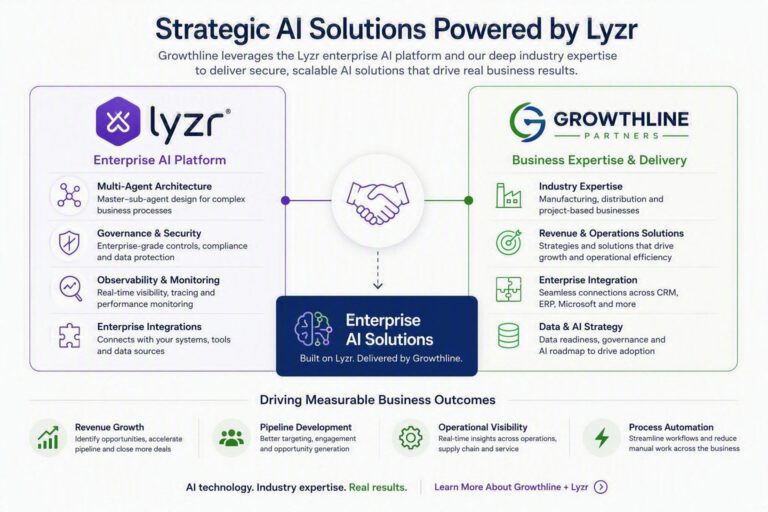
Growthline Partners uses the Lyzr enterprise AI agent platform as a core infrastructure layer for building secure, governed, and scalable AI solutions for manufacturing, distribution, and project-based businesses.
Lyzr provides the technical foundation required to design, deploy, monitor, and manage AI agents in production environments. As an Authorized Lyzr Partner, Growthline adds the business process knowledge, enterprise integration experience, data strategy, and industry expertise required to turn that technology into practical solutions that solve real revenue and operational challenges.
Why Growthline Built Its AI Practice on Lyzr
AI agents are quickly moving from experimentation to business-critical execution. But building a useful demo is not the same as deploying an enterprise-ready AI solution.
For AI agents to become trusted business tools, organizations need more than a language model and a workflow. They need an architecture that supports governance, security, observability, access control, auditability, integration, and scalability.
That is why Growthline selected Lyzr as a strategic AI platform.
Lyzr is designed to help organizations deploy, govern, and manage AI agents across enterprise environments. Its platform includes capabilities such as multi-agent orchestration, control plane management, simulation and evaluation, observability, hallucination and PII guardrails, access governance, and audit logging.
Growthline uses those platform capabilities to build AI agents and accelerators that connect to real business systems, work with trusted business data, and support defined business processes.
Lyzr Provides the Platform. Growthline Delivers the Solution.
Lyzr gives Growthline the AI agent infrastructure needed to build secure and scalable solutions.
Growthline brings the consulting, systems, integration, data, and industry expertise required to apply that infrastructure to real business problems.
Together, the combination enables AI solutions that are:
- Governed
- Observable
- Integrated
- Scalable
- Secure
- Business-process aware
- Designed for production use
- Independent of any single SaaS vendor or AI model
This is especially important for organizations that want to use AI across multiple systems, such as CRM, ERP, Microsoft 365, service platforms, external data sources, and operational systems.
What Makes Lyzr Different
1. Enterprise AI Agent Architecture
Many AI tools are built for simple prompts, isolated assistants, or individual productivity tasks. Lyzr is built for enterprise AI agent environments where multiple agents may need to work together across business functions, systems, and workflows.
Lyzr supports agent orchestration and control plane capabilities that allow organizations to manage agents across different frameworks, clouds, and large language models from a centralized environment.
For Growthline, this is important because most business problems are not solved by one generic AI assistant. Revenue generation, quote automation, customer intelligence, operational visibility, and supply chain analysis often require multiple specialized agents working together.
That aligns with Growthline’s master-agent and sub-agent delivery model.
A Growthline AI solution may include:
- An account research agent
- A contact discovery agent
- an email composer agent
- A CRM update agent
- A customer intelligence agent
- A quoting or proposal assistant
- An operational intelligence agent
- A reporting or executive briefing agent
Lyzr provides the platform architecture to coordinate these specialized agents as part of a governed business solution.
2. Governance Built Into the Platform
Growthline’s AI delivery philosophy is based on governance from the beginning, not governance added after the fact.
Lyzr’s platform includes governance-oriented capabilities such as agent registry, identity mapping, evaluation, staged promotion, observability, access controls, and audit logging.
That matters because enterprise AI agents may access customer data, CRM records, ERP information, emails, documents, pricing information, operational data, or other sensitive business content.
A CIO does not just need to know that an agent works. They need to know:
- What data the agent can access
- What tools the agent can use
- What actions the agent can take
- Who approved the agent
- How the agent is monitored
- How output quality is evaluated
- Whether activity can be traced and audited
- How the solution can be controlled if behavior changes
Lyzr’s governance capabilities support the level of oversight required for AI agents to move beyond experimentation and into business use.
3. Observability and Traceability
AI agents must be visible and measurable.
Lyzr provides observability capabilities including end-to-end traces, latency monitoring, cost-per-run visibility, and real-time monitoring of agent activity.
For Growthline clients, this supports a practical operating model:
- See what the agent did
- Understand which tools were called
- Review the sequence of actions
- Monitor performance and cost
- Identify failures or weak points
- Improve instructions, data sources, and workflows over time
This is one of the major differences between experimenting with AI and operating AI as part of an enterprise system.
4. Model Flexibility
Lyzr supports model flexibility, allowing organizations to work across different large language models rather than locking the AI environment into a single model provider. Lyzr describes this as the ability to run on any LLM and swap models without rewriting agents.
This is important because the AI model market is changing quickly.
The best model for sales research may not be the best model for document analysis, quoting support, service triage, or operational reporting. A vendor-independent AI architecture allows the organization to adapt as models improve, pricing changes, regulatory requirements evolve, or business needs shift.
Growthline believes AI architecture should preserve flexibility.
The goal is not to lock the client into a model. The goal is to create business solutions that can evolve.
5. Enterprise Integration
Growthline’s AI solutions are designed to work with the systems clients already use.
That may include:
- Salesforce
- Zoho CRM
- Microsoft 365
- Outlook
- Teams
- SharePoint
- ERP and MRP platforms
- SAP
- Oracle
- Acumatica
- Infor
- Shopify
- Service systems
- Quote and proposal platforms
- Data warehouses and reporting systems
Lyzr’s platform is designed to connect agents to enterprise systems, tools, and data sources, while Growthline provides the integration expertise required to make those connections meaningful in a business process.
This is a major distinction…AI becomes more valuable when it can work with actual business data, not just answer general questions.
Why Not Just Build Everything in a Workflow Tool?
Workflow platforms such as n8n, Zapier, or similar automation tools are useful for connecting systems and automating defined steps.
Growthline uses workflow automation where it makes sense.
But workflow automation and enterprise AI agent infrastructure are not the same thing.
A workflow tool is typically best when the process is known in advance:
When this happens, do that.
AI agents are different. They may need to interpret context, retrieve information, choose the right tool, reason through next steps, collaborate with other agents, and produce a business-specific output.
For that type of environment, organizations need more than workflow execution. They need:
- Agent orchestration
- Governance
- Tool control
- Access control
- Observability
- Evaluation
- Auditability
- Versioning
- Monitoring
- Human oversight
- Integration with data and systems
That is why Growthline views workflow automation as one part of the architecture, not the AI platform itself.
Why Not Build Everything Directly in LangChain?
LangChain is a powerful framework for developers building agents and LLM-powered applications. LangChain’s documentation describes an agent as a model calling tools in a loop until a task is complete, with a surrounding “harness” that includes prompts, tools, and middleware.
LangChain and related frameworks can be excellent for highly technical teams that want to build custom agent logic at the code level.
However, for many business environments, the challenge is not just building an agent. The challenge is managing the full lifecycle of agents in production.
That includes:
- Deployment
- Testing
- Governance
- Monitoring
- Security review
- Access control
- Traceability
- Version management
- Rollback
- Business-user oversight
- Cross-system integration
- Ongoing operational support
Lyzr helps address the enterprise operating layer around AI agents. Its control plane is positioned to govern agents built across different frameworks, clouds, and LLMs, including agents built with frameworks such as LangChain.
Growthline’s view is simple: LangChain can be an effective development framework. Lyzr provides a more complete enterprise platform for governed AI agent deployment and management.
For most Growthline clients, the goal is not to own a complex AI engineering framework. The goal is to deploy business-ready AI solutions that IT can approve, business leaders can trust, and users can adopt.
Why Not Build Everything Inside a Single SaaS Vendor’s AI Product?
Many SaaS vendors are adding AI agents to their platforms. Salesforce Agentforce, for example, is positioned by Salesforce as an AI agent platform for building, running, and scaling agents across customer service, employee support, sales development, appointment scheduling, and other Salesforce-related use cases.
These vendor-native AI tools can be valuable when the use case lives primarily inside that vendor’s ecosystem.
But many businesses do not operate inside one application.
A manufacturer, distributor, or project-based business may rely on:
- One CRM
- A separate ERP or MRP system
- Microsoft 365 for email, documents, and collaboration
- External data sources
- E-commerce platforms
- Service systems
- Spreadsheets and shared files
- Custom databases
- Industry-specific applications
- Operational systems on the shop floor
If the AI architecture is tied too tightly to one SaaS vendor, the organization risks making that vendor’s application the center of its AI strategy.
Growthline believes the center of the AI strategy should be the business process and the enterprise data model, not a single software vendor.
The Case for Vendor-Independent AI Architecture
A vendor-independent AI architecture gives organizations more flexibility and control.
It allows the AI solution to work across systems instead of being confined to one platform. It also helps protect the organization from unnecessary lock-in as AI models, SaaS platforms, pricing structures, and enterprise requirements continue to evolve.
Lyzr supports a more flexible approach because its control plane is designed to connect agents across different frameworks, clouds, and LLMs from a centralized governance layer.
For CIOs, this matters because vendor independence supports:
- Better long-term architectural flexibility
- Reduced platform lock-in
- More control over data access and governance
- The ability to choose the best systems for each business function
- The ability to use different AI models as the market changes
- Cross-platform workflows and intelligence
- A more durable enterprise AI strategy
Growthline’s position is not that SaaS-native AI agents are bad.
The position is that SaaS-native agents are usually best suited to SaaS-native use cases.
When the business problem crosses CRM, ERP, email, documents, external data, manufacturing systems, quote processes, and operational workflows, a vendor-independent AI agent platform is often the better architectural choice.
Why CIOs Should Care
For a CIO, the key question is not whether AI is interesting.
The key question is whether the AI environment can be trusted, governed, supported, integrated, and scaled.
Growthline’s use of Lyzr is intended to address those concerns directly.
CIO Evaluation Criteria
A Growthline + Lyzr solution is designed around the following principles:
Governance
AI agents should operate within clear permission structures, access rules, approval paths, and monitoring controls.
Security
Agents should access only the systems, data, and tools required for their defined role.
Observability
Agent activity should be traceable, reviewable, and measurable.
Integration
AI should connect with existing enterprise systems rather than create another disconnected application layer.
Vendor Independence
The organization should avoid making its AI strategy dependent on one SaaS vendor, one model provider, or one closed ecosystem.
Scalability
The architecture should support expansion from one use case to many use cases without rebuilding the foundation each time.
Business Alignment
AI agents should be designed around real business processes, not generic technology demos.
How Growthline Uses Lyzr
Growthline uses Lyzr as part of a structured AI delivery model.
1. Business Problem Identification
We start by identifying the business problem, not the agent.
Examples include:
- Improve pipeline generation
- Increase quote responsiveness
- Identify expansion opportunities
- Improve CRM data quality
- Automate account research
- Improve operational visibility
- Reduce manual reporting
- Support customer service workflows
- Improve executive decision support
2. Data and System Assessment
We identify the systems, data sources, and business rules required to support the solution.
This may include CRM, ERP/MRP, Microsoft 365, sales data, service data, product data, operational data, customer records, emails, documents, external research, and reporting systems.
3. AI Agent Architecture
We define the agents, sub-agents, tools, workflows, data access, and governance structure required to support the use case.
4. Integration and Configuration
We connect the solution to the systems and data sources required to make the agent useful in the real business environment.
5. Governance and Testing
We test agent behavior, validate outputs, review access, monitor performance, and refine business rules before broader rollout.
6. Deployment and Continuous Improvement
We deploy the AI solution, monitor usage, analyze performance, and improve the solution over time.
Examples of AI Solutions Built with Lyzr
Growthline uses Lyzr to support AI agents and accelerators across revenue and operations.
Revenue AI Solutions
- AI SDR systems
- Account-to-opportunity accelerators
- Account research agents
- Contact discovery agents
- Email composer agents
- CRM update agents
- Sales intelligence agents
- Opportunity pursuit assistants
- Customer expansion analysis
- Executive briefing agents
Operations AI Solutions
- Operational intelligence agents
- Production visibility assistants
- Inventory and supply chain intelligence
- Service workflow automation
- Quote and proposal assistants
- Project status intelligence
- ERP/MRP data analysis
- Exception monitoring and alerting
- Executive operations reporting
Cross-Functional Intelligence
- CRM and ERP data alignment
- Customer 360 intelligence
- Business performance monitoring
- Workflow automation
- Knowledge retrieval
- Document intelligence
- Management reporting
- Data quality improvement
Why Growthline + Lyzr Is Different
The value is not simply that Growthline uses Lyzr.
The value is that Growthline uses Lyzr within a business-first delivery model.
Many AI initiatives fail because they start with technology and then search for a use case.
Growthline starts with the business problem, identifies the required data and systems, designs the AI agent architecture, and then uses Lyzr to build a governed, scalable solution.
That combination is what makes the approach different.
Lyzr contributes:
- AI agent infrastructure
- Multi-agent orchestration
- Governance controls
- Observability
- Model flexibility
- Enterprise deployment capabilities
- Security and audit support
Growthline contributes:
- Manufacturing and distribution expertise
- Revenue and operations consulting
- CRM and ERP process knowledge
- Enterprise integration experience
- Data strategy
- AI solution design
- Implementation and adoption support
Together, the result is not just an AI agent.
The result is an enterprise AI solution designed to improve how the business works.
Frequently Asked Questions About Lyzr and Enterprise AI Agents
What is Lyzr?
Lyzr is an enterprise AI agent platform designed to help organizations build, deploy, govern, and manage AI agents across business environments. Lyzr includes capabilities for agent orchestration, governance, observability, access control, evaluation, and enterprise deployment. [lyzr.ai], [lyzr.ai]
Why does Growthline use Lyzr?
Growthline uses Lyzr because the platform supports the type of enterprise AI architecture required for secure, governed, scalable business solutions. Lyzr’s multi-agent capabilities, governance tools, observability, and model flexibility align with Growthline’s approach to building practical AI solutions around business problems, enterprise data, and system integration.
How is Lyzr different from workflow automation tools?
Workflow automation tools are useful for predefined processes. Lyzr is designed for AI agent environments where agents may need to reason, use tools, collaborate with other agents, access data, and operate within governance controls.
How is Lyzr different from LangChain?
LangChain is a developer framework for building agents and LLM-powered applications. Lyzr provides a broader enterprise platform layer for deploying, governing, observing, and managing AI agents across environments. LangChain may be appropriate for code-first development, while Lyzr is better aligned with governed enterprise AI deployment.
How is Lyzr different from Salesforce Agentforce?
Salesforce Agentforce is Salesforce’s AI agent platform focused on building and running agents within the Salesforce ecosystem and related customer, employee, sales, and service use cases. Lyzr supports a vendor-independent AI architecture that can work across multiple systems, models, clouds, and frameworks.
Why is vendor independence important for enterprise AI?
Vendor independence helps organizations avoid tying their AI strategy to one SaaS platform, one model provider, or one closed ecosystem. This is especially important when business processes span CRM, ERP, Microsoft 365, external data, operational systems, and industry-specific applications.
Can Lyzr integrate with CRM and ERP systems?
Lyzr is designed to support enterprise AI agents that connect with tools, systems, and data sources. Growthline extends that capability through integration experience with CRM, ERP/MRP, Microsoft 365, LinkedIn, and other business platforms.
Is Lyzr suitable for manufacturing and distribution companies?
Yes. Lyzr provides the platform infrastructure, while Growthline applies manufacturing, distribution, project-based business, CRM, ERP, and operational expertise to build AI solutions for industry-specific use cases.
What types of AI agents can Growthline build with Lyzr?
Growthline can use Lyzr to support AI agents for sales research, CRM intelligence, account pursuit, customer intelligence, quote support, operational visibility, service workflows, reporting, and executive decision support.
Build AI on a Platform Designed for Enterprise Use
AI agents need more than intelligence. They need governance, integration, observability, security, and a business process foundation.
Growthline Partners uses Lyzr to help organizations move from AI experimentation to practical, governed AI solutions that support real business outcomes.