- +1 (571)-418-4836
- info@growth.linellc.com
- 100 Bull Street Savannah, GA 31407

AI Readiness & Data Governance
Build Your AI on Data You Can Trust
AI is causing organizations to take a much closer look at their data, systems, permissions and information practices. What they discover often isn’t an AI problem at all.
Information is scattered across CRM, ERP, Microsoft 365, spreadsheets and other business applications. Data may be incomplete, duplicated or inconsistent. Employees may have access to information they no longer need while struggling to find information they do need. Critical processes may still depend on manual handoffs between systems.
These issues affect the business today. They impact reporting, automation, customer information, operational visibility, security and the ability of employees to make informed decisions.
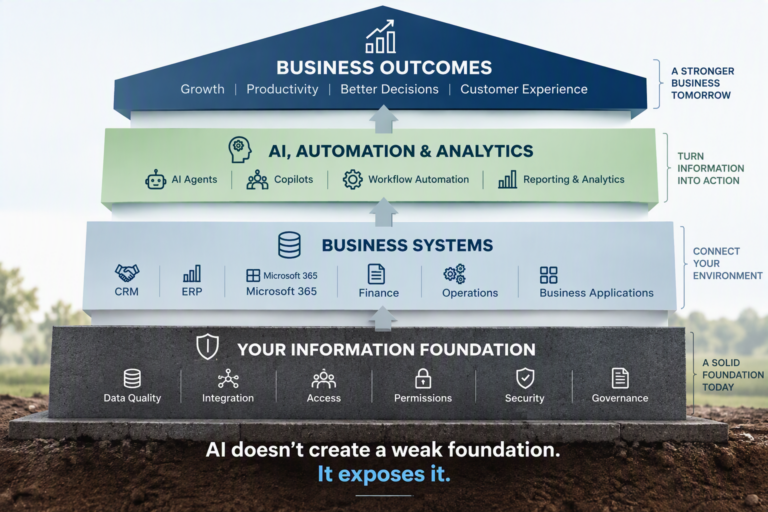
AI didn’t create these problems. It exposed them.
As organizations introduce copilots, AI agents and automation, those weaknesses become much harder to ignore. An AI system that can search, analyze and act on business information raises some very practical questions:
- What information can it access?
- What information should it access?
- Can employees find the information they need today?
- Is that information accurate and reliable?
- Are permissions appropriate?
- Which systems contain the authoritative information?
- Can information move securely between the systems that need it?
- What actions should people, automation and AI be allowed to take?
These are important questions whether your next investment is an AI agent, CRM improvement, ERP integration, Microsoft 365 automation or better reporting.
Start With the Foundation
You don’t renovate a house without understanding the condition of the foundation.
The same principle applies to your business information.
Let’s determine whether the foundation supporting your business information is sound. Then we can determine what AI, automation and system improvements it can safely support.
Growthline’s AI Readiness & Data Governance approach starts there. We examine the information your business depends on, where it resides, how it moves between systems, who can access it, whether it can be trusted, and how it supports the way people actually work.
The objective isn’t simply to make your organization “AI ready.”
It’s to create a stronger information foundation for the business you operate today and the capabilities you want to build tomorrow.
Start With How Your Business Uses Information
Every organization has a different mix of systems, data, processes and people. Before recommending AI, automation or a new technology, we start by understanding how information supports the business today and where that foundation is creating friction.
The goal is not to evaluate technology in isolation. It is to understand how information moves through the business, who needs it, where it comes from, whether it can be trusted, and what happens when it is incomplete, inaccessible or disconnected.
We Start With the Business
We look at the work people are actually trying to accomplish:
- What information do employees need to do their jobs effectively?
- What information is difficult to find, access or trust?
- Where are employees maintaining information outside the systems intended to manage it?
- Where are manual processes, duplicate entry or system handoffs creating unnecessary work?
- Where are incomplete or inconsistent data affecting decisions, customer interactions or operations?
- Where do employees have too much access, too little access, or access that is difficult to manage?
- Which reporting, automation or business processes depend on information from multiple systems?
This gives us a practical view of where the information foundation is already affecting the business, before AI enters the discussion.
Then:
We Examine the Foundation
- Data Quality & Integrity
- Systems & Information
- Integration & Flow
- Access & Permissions
- Security & Governance
- Automation & AI Readiness
Fix What Matters. Build From There.
The answer isn’t always an AI project.
The immediate opportunity may be better CRM data, tighter permissions, an integration between business applications, improved Microsoft 365 information management, workflow automation, or clearer ownership of critical business information.
In other situations, the foundation may be ready to support copilots, AI agents, intelligent workflows and more advanced automation.
The objective is to identify what will improve the business now while establishing a foundation that can support what comes next.
“Okay, what do you actually do with what you find?”
From Findings to Action
The purpose of AI Readiness & Data Governance isn’t to produce another assessment that sits on a shelf. It is to identify the issues that matter, determine what should be addressed first, and turn those findings into a practical plan for improvement.
Some problems can be addressed quickly. Others may require changes to data, systems, permissions, integrations or business processes before more advanced automation or AI makes sense.
Growthline helps separate the two.
Fix What Matters Now
Address problems already affecting operations, such as data quality, access, integration, reporting or broken processes.
Improve What Comes Next
Connect systems, improve workflows, automate repetitive work and make information easier to use across the organization.
Build What the Foundation Can Support
Introduce copilots, agents, intelligent automation and more advanced AI where the data, controls and business case support them.
The answer isn’t always an AI project.
There is no single technology platform or AI architecture that is right for every organization.
Zoho-Centered
For organizations whose core processes and information are already centered around Zoho, look first for opportunities to improve the existing environment and extend it through Zoho AI Solutions, automation, integrations and outside services when appropriate.
This reinforces the direction we’ve been developing recently: solve meaningful, immediate business problems without automatically introducing another AI platform.
Microsoft-Centered
Where work and information already live primarily across Microsoft 365, evaluate how information structure, governance, automation and Copilot can improve the way people find, use and act on that information.
Complex / Multi-Platform Enterprise
Where information and processes span platforms such as Salesforce, SAP, Microsoft and custom applications, a broader architecture may be appropriate. That’s where Lyzr Enterprise AI Solutions and cross-platform orchestration become part of the conversation.
Technology follows the business requirement.
What You Walk Away With
Know Where You Stand → Know What to Do Next
At the end of the process, you should have a clear understanding of your information foundation, the issues creating risk or holding the business back, and the opportunities worth pursuing.
The result is a practical blueprint that identifies:
- the business and information issues that need attention
- data quality and governance priorities
- access, permission and security concerns
- integration and system dependencies
- processes that can be improved or automated
- AI opportunities the environment can support
- issues that should be resolved before AI is introduced
- recommended technology and architecture where appropriate
- priorities for moving forward
The objective is clarity: what should we fix, what should we improve, what should we build, and in what order?
You don’t need an AI strategy disconnected from the rest of the business. You need a strong information foundation and a practical plan for what to build on top of it.