- +1 (571)-418-4836
- info@growth.linellc.com
- 100 Bull Street Savannah, GA 31407

AI Integration & Agent Architecture
Connect AI to the systems, data and workflows that run your business.
AI agents become valuable when they can do more than answer questions.
They need access to trusted business data, the right tools, external information and the applications where work actually happens.
But connecting those systems is only the beginning.
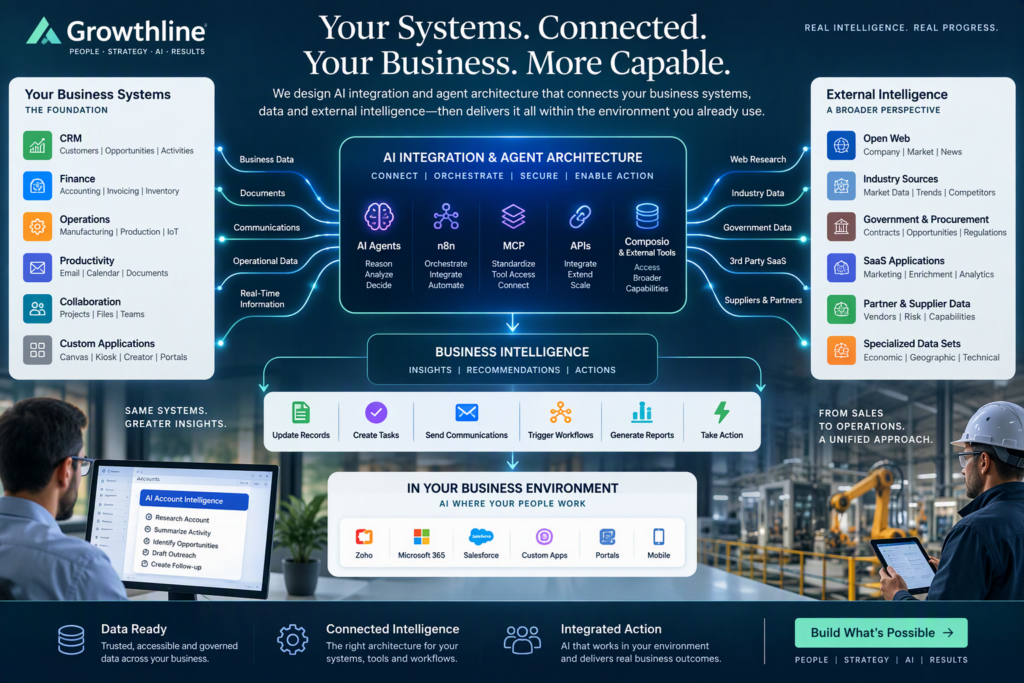
Growthline designs the integration and agent architecture that determines how AI accesses information, when it uses a tool, where workflows execute, which system remains authoritative, what actions require human involvement and how intelligence is delivered back into the business.
The result is AI that doesn’t sit beside your business systems. It works through them
Explore Your AI Architecture
Connected Doesn’t Mean Integrated
It has become remarkably easy to connect an AI model or agent to an application, API or database.
That does not mean the resulting solution is well architected.
An agent may have access to CRM, email, documents, ERP data, external research and automation tools, yet still operate inefficiently. Poor architecture can cause AI to retrieve the same data repeatedly, move unnecessarily between applications, lose important context, call expensive services when simpler methods are available, or take actions before the appropriate controls have been applied.
We have seen this firsthand.
A workflow can have working connections to a CRM system and email platform and technically accomplish the requested task, while the underlying design causes the AI to move repeatedly between systems instead of following a clear execution path.
Every component can work while the overall solution doesn’t work well.
That is why Growthline treats integration and agent architecture as a distinct part of implementing AI.
Connecting the tools is the easy part. Designing how they work together is where architecture begins.
From Trusted Data to Intelligent Action
AI readiness establishes the foundation: reliable data, appropriate governance and an understanding of where business information resides.
Integration and agent architecture builds on that foundation by determining how intelligence accesses and acts on that information.
1. Business Systems
CRM, ERP, Microsoft 365, finance, marketing, service, ecommerce, manufacturing and other operational applications remain the systems through which the business operates.
2. Enterprise Data
Customer records, transactions, communications, documents, opportunities, service histories, operational information and institutional knowledge provide the business context AI needs.
3. Integration & Orchestration
APIs, MCP, n8n, native application functions and integration platforms securely connect systems and control how information and actions move between them.
4. AI Intelligence
AI agents and models from platforms such as OpenAI, Zoho, Microsoft and Lyzr provide reasoning, analysis, research and decision support.
5. Business Action
Insights are converted into recommendations, CRM updates, workflows, communications, tasks, escalations and other business actions.
6. User Experience
Those capabilities are delivered back through the applications and interfaces where employees already work.
Together, these components create a closed intelligence loop:
Business Systems → Data → AI → Decision → Action → Business Systems
The Right Work in the Right Layer
Good AI architecture doesn’t send every problem to the language model.
Growthline separates reasoning from execution.
An AI agent may determine that an opportunity has stalled, analyze account activity and communications, identify a possible risk, and recommend the appropriate next action.
But a repeatable process such as retrieving records, transforming data, updating CRM, creating a task and notifying an account owner may be better executed through a deterministic workflow.
The distinction matters.
AI Agent
Workflow & Orchestration
Platforms such as n8n can coordinate multi-step processes, transform information, connect applications and execute deterministic workflows.
MCP
Model Context Protocol can provide a standardized interface through which AI applications access approved tools and information.
APIs & Native Tools
Direct APIs and application-specific functionality can provide the simplest path when an additional orchestration layer isn’t necessary.
Integration Platforms & External Services
Tools such as Composio can extend an agent’s reach to additional applications and information sources.
The goal is not to route everything through one technology. The goal is to give each component a clearly defined responsibility.
Internal Data Meets External Intelligence
Much of the information required to make a good business decision doesn’t live in a single application.
A CRM might tell an agent:
- Who the customer is
- What opportunities are open
- When the last activity occurred
- Who the important contacts are
- What has previously been discussed
But the business question may also require information outside CRM.
Depending on the use case, an AI solution may need authorized access to:
- Corporate websites and public information
- Industry and market information
- Government and procurement data
- Other SaaS applications
- Business intelligence sources
- Customer or supplier portals
- Operational systems
- Specialized third-party datasets
Growthline designs architectures that combine enterprise context with appropriate external intelligence, giving AI a more complete basis for analysis while maintaining clear control over where information comes from and how it is used.
Integration Doesn’t End at the API…
AI should work where your people work.
Connecting AI to business data solves only half the problem.
The other half is delivering intelligence and action back into the environment where work actually takes place.
Growthline can work on both sides of the integration.
We design the AI, tools and workflows behind the experience while also using the capabilities of platforms such as Zoho, Microsoft 365, Salesforce and other business applications to integrate those capabilities into existing processes and user experiences.
That can mean something as simple as an AI function launched directly from a CRM record.
A user opens an account and selects an AI research or analysis function.
Behind that one action, the solution might:
Retrieve CRM Context → Access External Sources → Analyze the Information → Recommend an Action → Update the Business Process
The employee doesn’t have to understand the technologies operating behind the screen.
The complexity should exist behind the experience, not in front of the user.
Close the Loop Through the System of Record
This is particularly powerful when the underlying business platform can itself be customized.
In a Zoho environment, for example, Growthline can design experiences that combine CRM customization, Deluge functions, custom buttons, guided experiences, custom applications and external AI and integration services.
The same architectural principle extends to Microsoft, Salesforce and other enterprise environments based on the capabilities available within those platforms.
Instead of requiring another standalone AI destination, intelligence can become part of the business process itself.
The experience may be simple:
Open Account → Request Account Intelligence → Review Recommendation → Take Action
Behind the experience:
System of Record → AI → Integration → Internal + External Data → Workflow → System of Record
That completes the loop.
The system of record is no longer merely somewhere AI retrieves information from. It can also become the environment through which people interact with AI and act on the results.
One Architecture Does Not Fit Every Business
Growthline does not begin an AI engagement by deciding that every customer should use the same agent platform.
The architecture should reflect the company’s existing technology, business requirements, complexity, economics and desired outcomes.
Zoho & Embedded AI
For organizations operating within Zoho, native automation and AI capabilities can provide tightly integrated solutions connected directly to business applications and workflows.
OpenAI Agents
Where broader reasoning, additional tools or greater architectural flexibility is appropriate, AI agents can operate outside the business application while remaining connected to Zoho, Microsoft, Salesforce and other systems through APIs, MCP and integration services.
Lyzr Enterprise Agent Architecture
For larger or more complex enterprise environments, a more comprehensive agent platform can provide an orchestration layer across enterprise applications, data and AI capabilities.
Microsoft & Other Enterprise Environments
The same design principles can be applied within Microsoft-centered environments and across other business platforms.
The technology follows the business requirement, not the other way around.
Architecture Designed Around Your Business
Before selecting technologies, Growthline starts with the way the business actually operates.
What systems are already in place?
CRM, ERP, finance, productivity, customer service, manufacturing, ecommerce and other applications.
Where does authoritative information reside?
We identify the systems of record and determine what information AI actually needs.
What requires reasoning?
Not every workflow step needs an LLM. We identify where AI adds meaningful judgment, interpretation, research or decision support.
What should be deterministic?
Repeatable transactions and system actions may belong in workflows, APIs or application automation rather than the reasoning layer.
What external intelligence is necessary?
We determine which external sources, services or datasets add meaningful context to the business decision.
What should AI be allowed to do?
Architecture includes appropriate permissions, authentication, controls and human involvement around consequential actions.
Where should employees interact with it?
The best interface might be a CRM record, Microsoft environment, custom application, portal or another existing point of work.
Only then do we determine the appropriate technology architecture.
Built for More Than Sales
Revenue and sales workflows are obvious places to begin, but the architecture applies across the business.
Sales & Revenue Operations
Account intelligence, opportunity analysis, research, follow-up, pipeline monitoring and next-best-action recommendations.
Capture & Proposal Management
Opportunity discovery, account intelligence, procurement information, requirements analysis, pursuit support and proposal workflows.
Customer Service
Customer context, case intelligence, knowledge retrieval, escalation support and service workflows.
Finance & Administration
Document processing, information retrieval, exception identification, workflow support and cross-functional business processes.
Manufacturing & Operations
AI architectures can connect customer, commercial and operational information with business workflows and external intelligence, while integrating with existing ERP, manufacturing, IoT and other operational environments as appropriate.
Management Intelligence
Bring information together across systems to help leadership understand customers, operations, risks, opportunities and emerging business conditions.
Why Architecture Matters
Organizations increasingly have access to powerful AI models. — That alone isn’t a competitive advantage. — The harder challenge is creating the architecture around those models:
What data can they trust?
What systems should they access?
What tools should they use?
When should they reason and when should a workflow execute?
What external information should be introduced?
What actions require human approval?
Where should the resulting intelligence appear?
How do you make the process reliable, secure and economically sensible?
Answering those questions is what turns a demonstration into a business capability.
The Growthline Approach
Trusted Data → Connected Intelligence → Integrated Action
Growthline brings together business systems, enterprise data, external intelligence, AI agents, APIs, workflows and user experiences to create practical AI capabilities around the way an organization already operates.
We aren’t trying to replace every business application with another AI platform.
We use the systems and data a company already has, identify where AI can create value, build the integration architecture around it, and extend that environment when additional capabilities are required.
The objective isn’t simply to build an agent.