
Building AI Agents Is Not the Hard Part — Operating Them Reliably Is
Lessons from Deploying AI Agents in Production
One of the most common misconceptions in the current AI market is that success in agent development is primarily about prompt quality, model selection, or workflow design. Those factors matter, but they are not what ultimately determine whether an AI agent succeeds in a production environment.
In real-world deployments, the challenge shifts quickly from can the agent do the task? to can the system do the task reliably, repeatedly, and safely under changing conditions?
That distinction is where many proof-of-concept projects stall, and where production-grade systems are either strengthened or exposed.
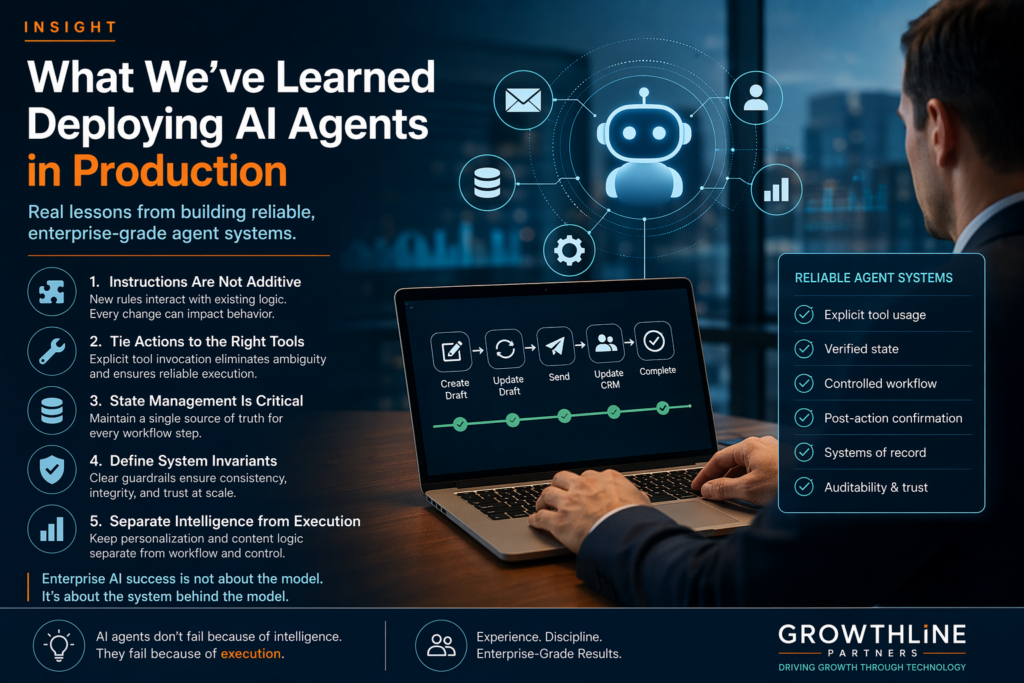
Lesson 1: Instructions Are Not Additive – They Are Interactive
A major lesson in production agent development is that new instructions do not simply “add” behavior. They interact with existing logic, priorities, and routing decisions. A change intended to improve formatting, personalization, or usability can unintentionally affect execution behavior, state handling, or system reliability.
This means instruction design must be treated as system design. In production environments, even small changes can alter how the agent interprets task completion, which tools it chooses, or how it manages state across steps.
The practical takeaway is clear: changes to an agent’s instructions must be introduced with the same discipline as changes to application logic.
Lesson 2: If a Step Matters, It Must Be Explicitly Bound to the Right Tool
A recurring challenge in agent reliability is ambiguity between intent and execution. Telling an agent to “create a draft in Outlook” may sound sufficient, but in practice the agent may interpret that instruction in several ways unless the required tool is explicitly named and the expected completion state is clearly defined.
This is one of the most important operational lessons in agent development: if a step matters, it should be tied to the precise system action that must occur. In production, tool specificity reduces interpretation errors, eliminates “soft completion,” and improves auditability.
Reliability improves significantly when the instruction does not merely describe the desired outcome, but also anchors that outcome to the execution mechanism.
Lesson 3: State Management Is More Important Than Prompt Quality
In demonstrations, agents often appear effective because the user sees a single successful output. In production, however, agents must maintain continuity across multiple actions: create, modify, verify, send, update, and close. The failure point is often not intelligence — it is state.
Production systems break when the agent loses track of the active object, references stale data, treats content as equivalent to a system record, or fails to understand whether a task has completed. This is especially true in workflows involving drafts, approvals, CRM updates, and external systems.
In practice, the most reliable agent systems establish a single source of truth for each workflow state and force all downstream actions to reference that state consistently.
Lesson 4: Production Agents Need System Invariants
Successful agent deployments benefit from a small number of non-negotiable operational rules. These are not stylistic preferences. They are execution invariants that preserve trust and consistency.
Examples include:
- defining a single valid state object for work in progress
- requiring verification before advancing to the next step
- separating draft creation from send execution
- updating systems of record only after confirmed success
- treating task completion as an explicit terminal state
Without these invariants, agents may appear functional while behaving inconsistently at the margins — which is exactly where trust is lost.
Lesson 5: Personalization and Execution Logic Must Be Seperated
One of the easiest mistakes in agent design is blending presentation logic with execution logic. Personalization, tone, formatting, and messaging are important, but they should not be allowed to interfere with workflow control, tool selection, or data integrity.
In production systems, stable execution logic should be locked down and treated separately from editable messaging layers. This allows teams to improve relevance and experience without destabilizing the underlying workflow.
This separation is essential for scaling client-facing agent systems safely.
Lesson 6: “Mostly Working” is Not a Production Standard
An agent that works 80–90% of the time in a lab environment may still be unacceptable in a production workflow, especially where client communication, auditability, or CRM integrity are involved. Reliability is not measured by whether the system can complete a task once. It is measured by whether it can perform correctly under repeated use, after modifications, and across edge cases.
This is why production agent development requires more than prompt writing. It requires operational discipline, testing against workflow state, controlled change management, and a clear understanding of what constitutes successful completion.
Lesson 7: Credibility Comes from Solving the Failure Modes Others Ignore
Many organizations are still focused on what AI agents can do. Fewer are focused on what causes them to fail in production: instruction conflicts, tool ambiguity, state drift, premature completion, and weak post-action verification.
Teams that have worked through these issues develop a much more practical understanding of enterprise agent deployment. That experience is valuable because it shifts the conversation from generic automation claims to system reliability, governance, and operational design.
That is ultimately what credibility in AI delivery looks like: not enthusiasm about possibility, but experience in making agent systems dependable.
Final Takeaway
The biggest lesson from production agent development is that enterprise AI success is not determined by model quality alone. It is determined by how well the system handles execution, state, verification, tool control, and change over time.
Organizations that treat agents as production systems rather than novelty interfaces will build more trust, move faster in the long run, and achieve better outcomes with less disruption.
We Can Help with your AI projects
If you’re building AI agents for CRM, RevOps, ABM, or sales operations—and you want them to be reliable, auditable, and safe to automate—that’s exactly the kind of work we do at Growthline.
Happy to compare notes, pressure‑test architectures, or share what we’ve learned.