
Start With What You Already Have...
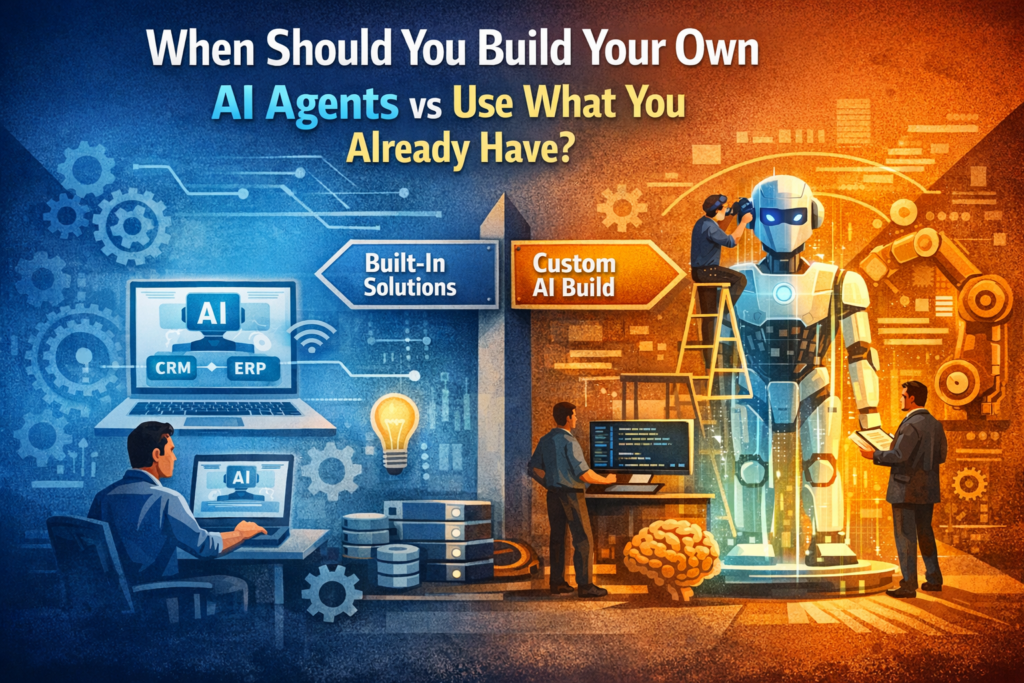
When Should You Build Your Own AI Agents vs Use What You Already Have?
Artificial intelligence is quickly becoming embedded in the tools companies already use—CRM systems, ERP platforms, marketing automation, and more.
Because of this, many organizations are asking the wrong first question:
“Should we build our own AI agents?”
In reality, the better question is:
“Do we even need to build anything yet?”
For many companies, the answer is no.
Start With What You Already Have
Most modern enterprise platforms already include AI capabilities.
Take Zoho as an example. Its built-in AI assistant, Zia, can:
- Answer questions about CRM data
- Surface insights
- Assist with reporting and basic automation
For organizations with relatively straightforward workflows, this type of embedded AI can provide meaningful value without requiring additional investment.
This approach works well when:
- Your workflows are contained within one platform
- Your processes are reasonably standardized
- Your primary need is visibility, reporting, or light automation
In these cases, AI acts as an extension of your existing system—not a new system to build.
Getting Value From Embedded AI (What Actually Matters)
When companies struggle with tools like Zia, it’s rarely because of the AI itself.
It’s usually because of the underlying data and process.
If you’re leveraging embedded AI, the biggest gains come from:
- Cleaning and standardizing CRM data
- Defining consistent workflows
- Starting with narrow, high-value use cases
- Avoiding the temptation to over-automate early
AI will only be as useful as the structure it operates within.
Where Things Start to Break Down
The limitations of embedded AI become clear when your business extends beyond a single system.
This typically happens when:
- Your CRM needs to coordinate with your ERP
- You rely on multiple platforms (Zoho, Microsoft, LinkedIn, etc.)
- You want AI to trigger actions—not just provide information
- Your processes span multiple departments or systems
At this point, the challenge is no longer about “AI capability.”
It becomes a systems problem.
When You Actually Need a Custom AI Approach
Some organizations reach a point where embedded AI tools are no longer enough.
This usually happens when:
- Your processes are a source of competitive differentiation
- You need orchestration across multiple systems
- You want AI to execute actions, not just provide insights
- You need consistent, controlled logic driving outcomes
In these situations, AI becomes part of your operational infrastructure, not just a feature.
This is where a more custom or orchestrated AI approach starts to make sense.
The Reality Most Companies Underestimate
This is also where many organizations run into problems.
Building AI agents is not simply a matter of prompts or connecting an API.
It involves:
- Coordinating multiple systems
- Managing data consistency
- Defining decision logic
- Handling edge cases and failures
- Maintaining the system over time
The complexity isn’t in using AI—it’s in integrating it into the way your business actually operates.
A Simpler Way to Think About It
You don’t need a complex framework to make this decision.
Start with this:
If your needs are contained within one platform:
Use the AI already built into your system.If your workflows span multiple systems and drive critical outcomes:
You may need a more advanced, orchestrated approach.If you don’t have the internal resources to design and maintain that system:
That’s where external expertise becomes important.
Final Thought
The goal isn’t to build AI agents.
The goal is to improve how your business operates.
For many organizations, that starts with getting more out of the systems they already have.
Only once those limits are reached does it make sense to consider building something more advanced—and even then, the focus should be on solving the problem, not building the technology.
We Can Help with your AI projects
If you’re building AI agents for CRM, RevOps, ABM, or sales operations—and you want them to be reliable, auditable, and safe to automate—that’s exactly the kind of work we do at Growthline.
Happy to compare notes, pressure‑test architectures, or share what we’ve learned.