
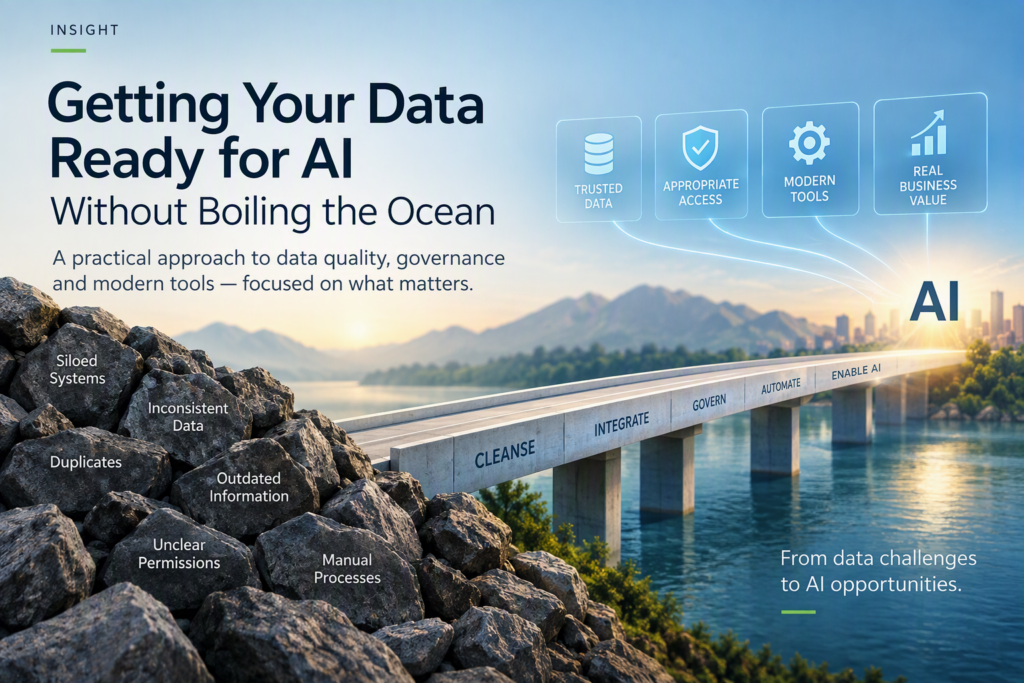
Preparing Your Data for AI
Getting Your Data Ready for AI Without Boiling the Ocean
AI readiness doesn’t require perfect data. It requires knowing what data matters, whether it can be trusted, who and what should have access to it, and what needs to be fixed first.
Organizations are moving quickly to adopt generative AI, Microsoft Copilot, AI-enabled CRM and ERP capabilities, and increasingly, AI agents that can perform work across multiple business systems.
That creates an understandable concern: Is our data ready for AI?
For many organizations, the honest answer is probably “not completely.”
Customer records contain duplicates. ERP and CRM systems don’t always agree. Important information lives in spreadsheets, documents, email and departmental applications. Data accumulated over years may have inconsistent ownership, access permissions and standards.
None of this is new.
Organizations have dealt with data quality, integration and governance issues long before generative AI appeared. What AI changes is both the importance of those issues and the potential consequences of ignoring them.
The answer, however, isn’t necessarily another enormous enterprise data initiative.
A more pragmatic approach starts with the business problems you want AI to help solve and works backward to determine what data those use cases require, whether that data is reliable, who should have access to it, and what AI should be permitted to do with it.
Start With the Business Use Case, Not the Data
A common mistake in data initiatives is trying to solve the entire enterprise data problem before delivering a business outcome.
AI gives us an opportunity to approach the problem differently.
Suppose the objective is to build an AI capability that helps sales identify neglected opportunities, recommends the next action and prepares appropriate follow-up communications.
That doesn’t require every piece of data in the organization to be perfect.
It does require us to understand the data that particular use case depends upon:
- Are accounts and contacts accurate?
- Are opportunities current?
- Are activities and customer interactions being captured?
- Can we reliably associate communications and activities with the right company, contact and opportunity?
- Does relevant information exist outside the CRM?
- Are there significant duplicates or conflicting records?
- Is the information current enough for AI to make useful recommendations?
An operational AI use case will require a different data set. It might depend on customers, products, orders, inventory, purchasing, production, financial information or other ERP data.
The principle is the same:
Start with what AI is supposed to accomplish. Then identify the information required to accomplish it.
That immediately reduces the size of the data problem.
Data Quality Matters Because AI Will Use What You Give It
AI doesn’t magically transform poor underlying information into reliable business information.
Consider something as straightforward as asking AI:
Which open opportunities should our sales team focus on this week?
If the CRM contains opportunities that should have been closed six months ago, incorrect stages, missing activities or duplicate accounts, an AI system reasoning over that information begins at a disadvantage.
The problem isn’t necessarily the AI.
It’s the information being supplied to it.
This makes traditional data disciplines increasingly important:
⇒ Completeness. Is the information AI needs actually present?
⇒ Accuracy. Does it correctly represent the business?
⇒ Consistency. Do different systems describe the same customer, product or transaction the same way?
⇒ Currency. Is the information recent enough to support the decision being made?
⇒ Uniqueness. Can we reliably identify a customer, supplier, contact, product or other business entity?
⇒ Context. Does AI have enough information to understand what the data actually means?
But that still doesn’t mean every database needs to be scrubbed from top to bottom before an organization can use AI.
It means organizations need to identify where poor data can materially affect specific AI use cases and fix what matters first.
Data Quality Is Only Half the Question
There is another AI readiness issue that gets considerably less attention:
Who has access to the information?
Microsoft 365 Copilot provides a useful illustration.
Microsoft states that Copilot grounds its responses in information users already have permission to access. Importantly, Microsoft also makes remediation of oversharing the first step in its guidance for establishing a secure and governed foundation for Copilot. Its guidance calls for organizations to identify high-risk sites and sensitive content, apply protections, and remediate access and permissions.
There is an important distinction here.
Copilot isn’t simply ignoring Microsoft’s permissions model. The more interesting question is whether the existing permissions are appropriate in the first place.
That’s a data governance question, not simply an AI question.
Before AI, someone might technically have had access to information but still needed to know that it existed, know where it was stored and go looking for it.
AI changes the nature of information discovery. Microsoft describes Copilot as helping people find information and summarize content using data they already have permission to access.
That should cause organizations to take another look at permissions that may have accumulated over years.
Microsoft’s own Copilot governance blueprint specifically addresses oversharing, access, sensitive content, guardrails and data hygiene.
For executives, the question becomes remarkably straightforward:
How confident are we that our people only have access to the information they should have access to?
AI didn’t create that question.
It made the answer more important.
Read Access Is Different From Permission to Act
The governance discussion becomes even more important as organizations move from generative AI toward agentic AI.
There is a fundamental difference between an AI system that can retrieve information and one that can change business information or initiate a process.
Consider the progression:
Read → Retrieve customer information.
Analyze → Determine that an opportunity appears stalled.
Recommend → Suggest the appropriate next action.
Prepare → Draft the follow-up communication.
Execute → Send the message or update the CRM.
Those shouldn’t automatically carry the same level of authorization.
An organization might be comfortable allowing an AI agent to analyze an opportunity and recommend a next step while still requiring human approval before sending communications or modifying certain records.
AI governance therefore needs to look beyond:
What information can AI see?
and also ask:
What is AI allowed to do?
That distinction becomes particularly important as AI is connected more deeply into CRM, ERP, Microsoft 365 and other operational systems.
Modern Tools Can Change the Economics of Data Readiness
This is where AI readiness can look very different from traditional large-scale data programs.
Historically, assessing, cleansing, transforming and integrating large amounts of enterprise data could involve considerable amounts of consulting and technical labor.
Modern data preparation, integration, automation and governance technologies provide another option.
For example, Zoho describes Zoho DataPrep as an AI-powered self-service ETL platform that can move, cleanse, transform and enrich information from multiple sources. It provides visual data pipelines, workflow automation, scheduling and trigger-based execution. [help.zoho.com], [help.zoho.com]
That makes technologies such as DataPrep useful beyond traditional reporting and analytics.
They can become part of an AI-readiness architecture.
An organization might use modern tools to:
- profile source data,
- identify missing or problematic information,
- standardize data,
- address duplicates,
- transform information between systems,
- create repeatable data pipelines,
- monitor ongoing data movement, and
- deliver prepared information into downstream applications.
Zoho specifically documents missing, duplicate, old or redundant data among the data-quality issues its DataPrep platform is designed to help address. [help.zoho.com]
The specific technology will vary by environment. A company operating primarily on Zoho may have a different architecture from one built around Microsoft, Salesforce, SAP, Oracle, Infor or other platforms.
The objective isn’t to force every organization onto another data platform.
It’s to use the appropriate technology and experienced people to reduce the amount of manual work required to get business-critical data into usable shape.
That changes the economics of the problem.
A Pragmatic AI Readiness Model
Rather than beginning with an enterprise-wide mandate to “make our data AI-ready,” organizations can work through a much more manageable sequence.
1. Identify the business opportunity
Define where AI could create measurable value.
Sales productivity, customer intelligence, operations, service, financial analysis and knowledge management each create different requirements.
2. Identify the data required
Determine which CRM, ERP, Microsoft 365, operational, database and unstructured information actually supports that use case.
3. Assess whether the data can be trusted
Look for material problems involving completeness, accuracy, consistency, duplication, currency and context.
Don’t immediately fix everything.
Determine what could cause the AI use case to produce an unreliable result.
4. Assess access and governance
Determine who currently has access to the information and whether those permissions still reflect business requirements.
For Microsoft 365 Copilot environments, Microsoft’s own secure-and-govern guidance explicitly includes remediating oversharing and establishing access guardrails.
5. Establish AI boundaries
Determine what AI can:
read → analyze → recommend → prepare → execute
and where human approval should remain.
6. Use technology to remediate efficiently
Apply data preparation, integration, governance and automation technologies where they can replace repetitive manual work.
Reserve experienced people for the areas where judgment is actually required.
7. Deploy, measure and expand
Prove that an AI use case produces value.
Then expand the underlying data and governance model as additional AI capabilities are introduced.
AI Readiness Is a Business Discipline, Not Just an IT Project
Perhaps the most important change is organizational.
AI readiness sits at the intersection of business strategy, enterprise applications, data, security and governance.
IT may understand the systems.
Sales, operations, service and finance understand how the information is actually used.
Security understands access and risk.
Business leadership determines which uses of AI are worth pursuing.
These perspectives need to converge.
The objective shouldn’t be to produce another assessment document that eventually sits on a shelf.
It should be to answer a practical set of questions:
Where can AI create meaningful business value?
What data does it need?
Can that data be trusted?
Who and what should have access to it?
What should AI be allowed to do?
What needs to be fixed now, and what can wait?
What technology can reduce the cost and effort required to get there?
Those answers form the basis of a practical AI and data roadmap.
You Don’t Have to Boil the Ocean
Organizations shouldn’t wait for perfect enterprise data before moving forward with AI.
Perfect data is an unrealistic standard.
Unmanaged data is the opposite extreme.
The pragmatic path lies between the two.
Start with high-value AI opportunities. Identify the data they depend upon. Determine whether that data is trustworthy and appropriately governed. Use modern tools to remediate what matters. Put appropriate controls around AI access and actions. Measure the business impact, and then expand.
AI has changed what’s possible.
It has also increased the importance of some very familiar disciplines: data quality, systems integration, permissions, security and governance.
The good news is that the tools available to address those challenges have changed as well.
Organizations don’t necessarily need a massive transformation initiative to become AI-ready.
They need a practical plan for getting the right data, controls and technologies in place for the AI opportunities that matter most.