
What It Takes to Make Enterprise AI Work Growthline Partners
Why Production AI Requires More Than a Good Model
Building an AI agent can be surprisingly easy. Building one that works reliably, economically, and usefully inside a real business is something entirely different.
One of the best signs that an enterprise AI solution has been well designed is that the user may never see most of its complexity.
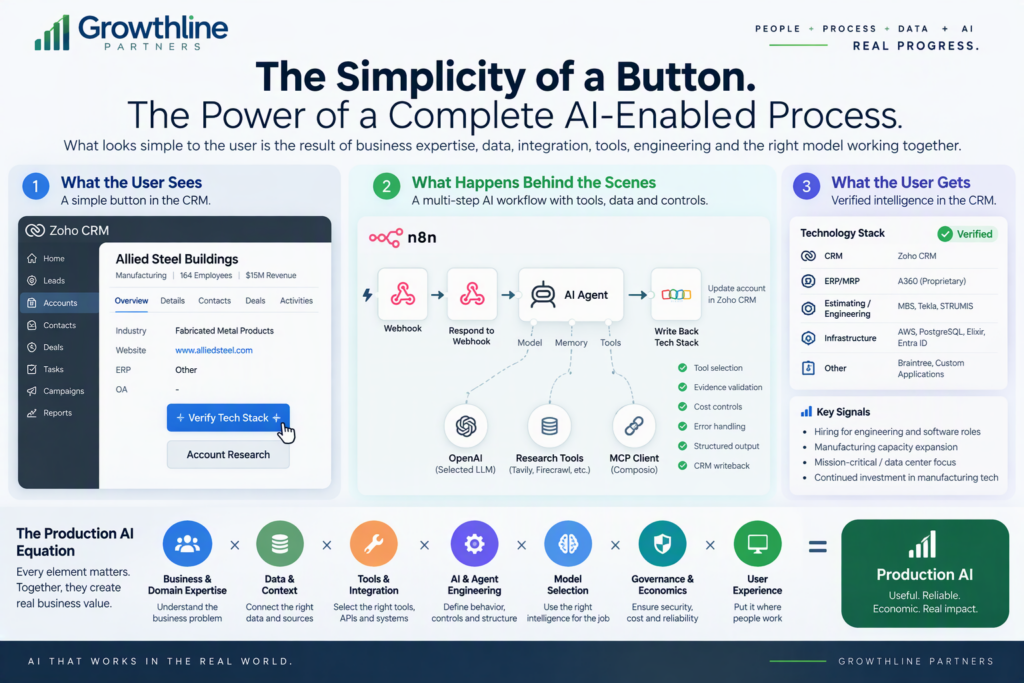
We recently developed an AI capability that appears remarkably simple to the user.
A salesperson opens an account in the CRM and clicks Verify Tech Stack.
The system researches the company, evaluates evidence about its CRM, ERP, manufacturing and engineering applications, identifies relevant infrastructure and business signals, and returns that intelligence directly to the account record.
From the user’s perspective, it’s a button.
Behind that button is a very different story.
Getting the capability to produce a result wasn’t particularly difficult. Getting it to produce a result we trusted, at an acceptable cost, using the right evidence, and in a form useful to the business was considerably harder.
That distinction is important.
There is a growing assumption that creating enterprise AI solutions is largely a matter of connecting an LLM to some data, adding a few tools, writing a prompt, and building a workflow.
That may produce an agent.
It doesn’t necessarily produce a production AI system.
A Simple Workflow Can Hide a Lot of Engineering
Look at many modern AI workflows and they appear deceptively simple.
A request enters the workflow. An AI agent processes it. The agent uses one or more tools. A result comes back. The result is written into a business application.
The visual workflow might contain only a handful of nodes.
But the number of boxes on a workflow diagram tells you almost nothing about the complexity of making the process work properly.
In our technology-verification example, several variables had to work together.
The research tools needed to find useful evidence rather than simply return lots of search results. The agent needed access to the appropriate tools and needed to understand how and when to use them. Tool schemas had to expose the right capabilities. The language model needed sufficient reasoning ability for the task. Agent instructions had to establish rules for evidence, company identification, failed searches, extraction, and output.
And all of it had to operate within acceptable boundaries for cost and execution time.
During testing, for example, we encountered a research approach capable of consuming roughly $5 in tool costs within seconds.
Five dollars isn’t going to change the economics of a consulting project.
But $5 multiplied across hundreds or thousands of automated executions certainly can.
That’s when AI architecture becomes business architecture.
The Production AI Equation
We have come to think about successful enterprise AI as a combination of several interdependent disciplines:
Business & Domain Expertise
X
Enterprise Data & Context
X
Tools & Integration
X
AI & Agent Engineering
X
Model Selection
X
Governance & Economics
X
User Experience
= Production AI
We use multiplication intentionally.
If one component is weak enough, the performance of the entire system can deteriorate.
A powerful LLM operating with poor data is still operating with poor data.
Excellent data connected through the wrong tools can’t reliably produce the required result.
Great tools combined with weak operating instructions can produce inconsistent behavior.
Technically sophisticated AI without subject-matter expertise can produce impressive answers that solve the wrong business problem.
And a system that works beautifully but costs too much to operate isn’t much of a production system.
1. Business Knowledge Comes Before AI
This is perhaps the most overlooked element of agent development.
Before deciding which model or AI platform to use, someone needs to understand:
What is the business trying to accomplish?
Consider something as seemingly straightforward as technology research.
Finding that a manufacturing company uses a CRM system, an ERP platform, an engineering application, and a database is useful information.
But it isn’t yet intelligence.
Someone needs to understand why those systems matter.
How does a customer opportunity move from sales through estimating?
How does the ERP interact with engineering?
Where does product or configuration information originate?
What happens when a quote becomes an order?
Where might information be manually reentered?
Where do finance, operations, manufacturing, sales, and customer service need the same information?
Those questions require business and subject-matter knowledge.
A sales agent needs an understanding of sales.
A finance agent needs finance expertise.
A manufacturing agent needs to understand manufacturing processes.
An agent analyzing enterprise applications needs to understand what those applications do and how they participate in business processes.
AI does not eliminate the need for subject-matter expertise. It increases the value of embedding that expertise into the system.
2. Enterprise Data Has to Become Context
Production AI also needs more than access to data.
It needs context.
Consider an account-intelligence system. Potential information might include:
- account and firmographic information
- contacts and organizational roles
- opportunities
- CRM notes
- calls and activities
- emails
- campaign engagement
- technology intelligence
- external company research
- previous proposals and projects
Simply handing everything to a language model is not necessarily the answer.
The system must understand what information is authoritative, what is third-party evidence, what is historical, what is current, and what remains unverified.
That becomes especially important when AI moves beyond summarization into recommendations.
There is an enormous difference between:
“Research suggests the company uses this technology.”
and:
“This technology has been verified as part of the company’s current architecture.”
Production AI needs to understand that distinction.
So do the people relying on its recommendations.
3. Tool Selection Is Part of the Intelligence
Tools also have a much larger influence on agent quality than is generally recognized.
Giving an AI agent access to “web search,” for example, doesn’t solve web research.
Different search, scraping, enrichment, API, and enterprise-data tools can return dramatically different information.
Some are excellent at discovering sources.
Others are better at extracting information from a specific page.
Some return concise structured data.
Others return enormous amounts of content.
Some are inexpensive.
Others can become expensive very quickly.
The agent then needs to know which tool to use, when to use it, and when to stop.
Tool architecture therefore affects:
- quality
- accuracy
- completeness
- latency
- reliability
- token consumption
- third-party API consumption
- operating cost
In a production environment, those aren’t implementation details.
They’re part of the design of the product.
4. Agent Instructions Are Operational Controls
Prompts are another area where terminology can undersell what is actually happening.
A useful production agent isn’t simply given clever wording that produces a better response.
Its instructions may establish:
its business role and objective
what evidence it may use
what systems or tools it can access
how tools should be selected
what constitutes sufficient evidence
how entities should be identified
how conflicting information should be handled
what may be inferred
what must remain unverified
how errors should be handled
when further research should stop
what output structure is required
At that point, we aren’t simply prompting an LLM.
We are defining operational behavior.
And those instructions rarely emerge perfectly on the first attempt.
Production systems are tested against real accounts, transactions, documents, exceptions and edge cases. Failures reveal where controls need to be strengthened. Instructions change. Tools change. Models change. The system is tested again.
That iterative process is part of AI engineering.
5. The Right Model Depends on the Job
There is also no reason every AI task should use the most sophisticated model available.
In fact, doing so can be wasteful.
Many business processes contain tasks such as:
extracting fields
categorizing information
formatting data
classifying records
normalizing values
identifying simple patterns
routing work
Those tasks can often be performed effectively by smaller, faster, less expensive models or even deterministic logic.
Other tasks require considerably more reasoning.
For example:
Given everything we currently know about this company, its people, technology environment, previous activity, opportunities, business conditions and engagement history, what opportunities should we pursue, why should we pursue them, who should be involved, and what should happen next?
That’s fundamentally different.
It requires synthesis and judgment across multiple sources.
We’ve seen firsthand that changing the model in those situations can produce dramatically different business outputs.
The lesson isn’t simply to use a more powerful model.
It’s to use the appropriate intelligence for the appropriate task.
Use inexpensive intelligence where the task is routine and deterministic.
Use deeper reasoning where the quality of judgment creates business value.
That approach improves both performance and AI economics.
6. Production AI Requires Financial Engineering Too
The economics of an AI workflow need to be designed just as deliberately as its functionality.
An agent may consume:
- model tokens
- search credits
- enrichment credits
- API calls
- scraping services
- orchestration resources
- database resources
- external application fees
A workflow that costs $0.05 per execution behaves very differently economically from one that unexpectedly costs $5.
Multiply both across 10,000 executions.
That’s the difference between $500 and $50,000.
Production AI therefore needs cost boundaries, appropriate models, controlled tool selection, stopping conditions, failure handling, and monitoring.
The question isn’t simply:
Can the agent accomplish the task?
It is also:
Can the agent accomplish the task reliably at an economically sustainable cost?
7. And Then There Is the User
This may be the most important part.
None of the complexity described above should necessarily be visible to the person using the system.
In our example, the salesperson doesn’t need to understand models, schemas, APIs, search tools, scraping, agent orchestration, or integration architecture.
The salesperson is already working inside the CRM.
The salesperson sees:
Verify Tech Stack
Click.
The system does the work.
The intelligence returns to the account where it can become part of the next business decision.
That is dramatically different from handing employees another AI application and asking them to become prompt engineers.
Good enterprise AI should reduce complexity for the user, not transfer technical complexity to the user.
Sometimes the most sophisticated AI architecture should ultimately result in something as simple as a button.
The Agent Is Only Part of the System
This is why we believe the current fascination with “AI agents” can sometimes obscure the bigger opportunity.
Companies don’t really need more agents.
They need better business outcomes.
That might mean:
- discovering better prospects
- understanding an account more completely
- identifying stalled opportunities
- accelerating complex quoting
- reducing manual data movement
- connecting sales and operations
- improving forecasting
- identifying manufacturing exceptions
- giving finance earlier visibility
- helping employees make better decisions
The agent is a component of that solution.
So are the CRM, ERP, integration layer, APIs, data, security model, workflow, subject-matter expertise, and user experience.
The real objective is an AI-enabled business process.
From Account Research to Account Intelligence
Our own work in sales and account intelligence illustrates how quickly these capabilities can build on one another.
An AI-enabled process can:
Discover accounts
based on geography, industry, company profile, and other business criteria.
↓
Verify the technology environment
rather than relying entirely on unconfirmed third-party enrichment.
↓
Build the account context
inside the CRM using contacts, notes, research, opportunities, activity, and external intelligence.
↓
Engage through sales and marketing workflows
↓
Observe new signals and activity
↓
Analyze the account
↓
Identify potential opportunities
↓
Recommend what should happen next
At the beginning of the process, AI may simply be helping find a company.
Farther downstream, AI can begin connecting business context:
What systems does the company operate?
Where might those systems create process or integration gaps?
What has our previous engagement told us?
Is an existing opportunity actually progressing?
Who should be involved?
What additional evidence do we need?
What is the next best action?
That progression is important.
The value isn’t simply the ability to generate more content.
The value is using intelligence to make a business process better.
Production AI Is a Team Sport
This also explains why enterprise AI increasingly requires a broader combination of expertise.
A subject-matter expert may understand the business process.
An enterprise application consultant may understand the CRM or ERP.
An integration engineer understands APIs and data movement.
An AI engineer understands models, tooling and agent behavior.
A data specialist understands structure, quality and governance.
A UX designer understands how capabilities should appear within someone’s daily work.
A strong production solution brings these disciplines together.
AI does not eliminate those areas of expertise.
It connects them.
And increasingly, that combination determines whether an AI initiative gets stuck in a demonstration or becomes part of how the company actually operates.
The Measure of Production AI
The industry will continue to introduce more powerful models, better agent frameworks, new integration protocols and increasingly sophisticated tools.
All of that matters.
But the measure of success should remain remarkably practical.
Does it solve a real business problem?
Does it have the information required to make a good decision?
Can it distinguish evidence from assumption?
Does it work reliably?
Is it secure and governed appropriately?
Can it operate at an acceptable cost?
Can people actually use it within their existing work?
And ultimately:
Does it improve the business outcome?
Because building an agent that works in a demonstration is becoming relatively easy.